

Cognitive Effects of Untreated Hearing Loss
What is the relationship between hearing loss and cognitive function?
Meta-analysis has revealed small but significant associations between age-related hearing loss and cognitive decline and impairment.6 While the mechanisms responsible for these associations are unclear, it has been hypothesized that hearing loss may impact cognitive function directly due to the impact of decreased sensory input on brain structures involved in cognition, or indirectly via decreased participation in physical, social, and/or cognitively stimulating activities. Alternatively, both hearing loss and cognitive impairment could be due to common disease processes or lifestyle-health risk factors (e.g., smoking, low educational level, cardiovascular disease).7
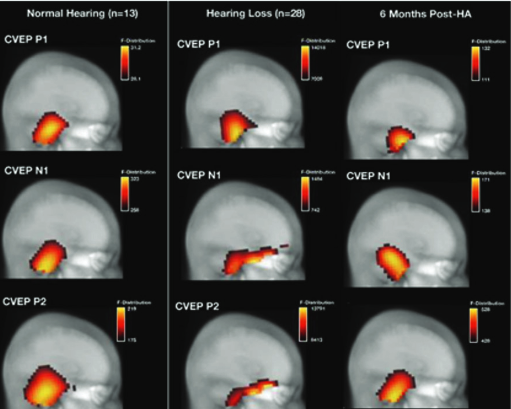
Facts About Hearing Loss
- Eliminating hearing loss would reduce the prevalence of dementia by an estimated 8% – more than any other potentially modifiable risk factor.8
- There is evidence that hearing aid use may delay or reduce declines in cognitive performance in older adults with hearing loss, particularly among individuals at greater risk of dementia.9,10
- Recent findings of a potentially protective effect of hearing intervention on risk of cognitive decline indicate the need for interprofessional collaboration with the goal of developing a more holistic approach to the provision of hearing care.11

Hearing Aids and Cognitive Health: Research Highlights
Emerging research shows that treating hearing loss with hearing aids may play a meaningful role in slowing cognitive decline in older adults. Two major studies, ACHIEVE and ENHANCE, demonstrate that hearing intervention can support memory, thinking skills, and overall brain health, especially in individuals at higher risk for cognitive decline.
ACHIEVE Study Findings
Hearing aids slowed down loss of thinking and memory abilities by 48% over 3 years for at-risk adults.13, 14
ENHANCE Study Findings
Cognition was stable for hearing aid users but declined for the non-hearing aid user group.13, 14
How We Can Help
It is important to understand the correlation between untreated hearing loss and cognitive decline, memory, and dementia. In addition to diagnosing hearing loss, we responsibly educate about the link between hearing loss and cognitive decline, and work to treat hearing loss.
References:
1. Roy, E. (2013). Cognitive Impairment. In: Gellman, M.D., Turner, J.R. (eds) Encyclopedia of Behavioral Medicine. Springer, New York, NY. https://doi.org/10.1007/978-1-4419-1005-9_1118
2. Petersen, R. C., Doody, R., Kurz, A., Mohs, R. C., Morris, J. C., Rabins, P. V., Ritchie, K., Rossor, M., Thal, L., & Winblad, B. (2001). Current concepts in mild cognitive impairment. Archives of neurology, 58(12), 1985–1992. https://doi.org/10.1001/archneur.58.12.1985
3. Anand, S., & Schoo, C. (2024). Mild Cognitive Impairment. In StatPearls. StatPearls Publishing.
4. Mayo Foundation for Medical Education and Research. (2024, February 13). Mild cognitive impairment (MCI). Mayo Clinic. https://www.mayoclinic.org/diseases-conditions/mild-cognitive-impairment/symptoms-causes/syc-20354578
5. Petersen R. C. (2016). Mild Cognitive Impairment. Continuum (Minneapolis, Minn.), 22(2 Dementia), 404–418. https://doi.org/10.1212/ CON.0000000000000313
6. Loughrey, D. G., Kelly, M. E., Kelley, G. A., Brennan, S., & Lawlor, B. A. (2018). Association of Age-Related Hearing Loss With Cognitive Function, Cognitive Impairment, and Dementia: A Systematic Review and Meta-analysis. JAMA otolaryngology– head & neck surgery, 144(2), 115-126. https://doi.org/10.1001/jamaoto.2017.2513
7. Dawes, P., & Völter, C. (2023). Do hearing loss interventions prevent dementia? Z Gerontol Geriatr, 56(4), 261-268. https://doi.org/10.1007/s00391-023-02178-z
8. Livingston, G., Huntley, J., Sommerlad, A., Ames, D., Ballard, C., Banerjee, S., … Mukadam, N. (2020). Dementia prevention, intervention, and care: 2020 report of the Lancet Commission. Lancet (London, England), 396(10248), 413–446. https://doi.org/10.1016/S0140-6736(20)30367-6
9. Lin, F. R., Pike, J. R., Albert, M. S., Arnold, M., Burgard, S., Chisolm, T., … ACHIEVE Collaborative Research Group (2023). Hearing intervention versus health education control to reduce cognitive decline in older adults with hearing loss in the USA (ACHIEVE): a multicentre, randomised controlled trial. Lancet (London, England), 402(10404), 786-797. https://doi.org/10.1016/S0140-6736(23)01406-X
10. Sarant, J. Z., Busby, P. A., Schembri, A. J., Fowler, C., & Harris, D. C. (2024). ENHANCE: a comparative prospective longitudinal study of cognitive outcomes after 3 years of hearing aid use in older adults. Frontiers in aging neuroscience, 15, 1302185. https://doi.org/10.3389/fnagi.2023.1302185
11. Stropahl, M., Scherpiet, S., & Launer, S. (2024). Viewpoint on the Benefit of Hearing Care on Cognitive Health. American journal of audiology, 1–5. Advance online publication. https://doi.org/10.1044/2024_AJA-23-00176
12. Campbell, J & Sharma, A. (2014, February 28). Cross-Modal Re-Organization in Adults with Early-Stage Hearing Loss. PLoS ONE, 9(2), 1-8. doi: 10.1371/journal.pone.0090594
13. Lin, F. R., Pike, J. R., Albert, M. S., Arnold, M., Burgard, S., Chisolm, T., … ACHIEVE Collaborative Research Group (2023). Hearing intervention versus health education control to reduce cognitive decline in older adults with hearing loss in the USA (ACHIEVE): a multicentre, randomised controlled trial. Lancet (London, England), 402(10404), 786-797. https://doi.org/10.1016/S0140-6736(23)01406-X
14. Sarant, J. Z., Busby, P. A., Schembri, A. J., Fowler, C., & Harris, D. C. (2024). ENHANCE: a comparative prospective longitudinal study of
cognitive outcomes after 3 years of hearing aid use in older adults. Frontiers in aging neuroscience, 15, 1302185. https://doi.org/10.3389/
fnagi.2023.1302185
Ready for Better Hearing? Call Today!
Our team is here to answer your questions and schedule your visit.